Showing posts with label Winter. Show all posts

Sunday, January 30, 2011

Winter Woodpeckers at Protection Farm

We have three Woodpecker species at Protection Farm during the winter months that regularly visit the feeding stations. 

 Hairy Woodpecker  Piocedes villosus
This is the larger of the two "twin" Woodpeckers, the Hairy and the Downy

Downy Woodpecker Picoides pubescens
Noticebly smaller, you can easily compare these two feeding here on the same suet feeder
  Red-bellied Woodpecker Melanerpes carolinus


The Pileated Woodpecker (Drycopus pileatus) is unusual to see during the winter and slightly more common in the summer and fall. They are certainly here but they do not visit the feeders where we observe most of our winter birds. I have seen the Pileated at least twice this month, flying over the meadow but the intense cold and constant snow has kept me inside more than I would like. In the summer they are still difficult to see, but you can hear them frequently. They keep their distance. I know of a nesting hole about a mile from the farm across the marsh. Several years ago when we lived in Java NY at Hobbit Hollow we had a family nest just outside of our house. We spent an entire season closley observing mom and dad and two young. They were an extremely tight knit family.  I had, but long ago lost, a really neat photo of the four of them on a Norway Spruce trunk at about eye level.   Pileated have a territory of about 1 mile in which they are fairly protective. I occasionally see individuals coming over Protection Farm from the east and the west, and I assume that this farm is in a disputed territorial area.

Northern Flickers are also common here in the warmer months.


Woodpecker Order is Picaformes and the family is Picidae. Picidae are known as or “near passerines” which is the way ornithologists describe birds that basically hang out in and around trees. Woodpeckers are highly adapted to search for food and nest in trees.

There are about 200 species of Woodpecker worldwide. There are 54 species listed by the American Ornithological Union in its checklist area which covers North and Central America from the North Pole to the boundary of Panama and Colombia, including the adjacent islands under the jurisdiction of included nations; the Hawaiian Islands; Clipperton Island; Bermuda; the West Indies including the Bahama Islands; the Greater Antilles; Leeward and Windward Islands in the Lesser Antilles (ending with Grenada); and Swan, Providencia, and San Andres Islands in the Gulf of Mexico. Greenland is not currently included in the AOU (7th Edition)  

The National Geographic Society Field Guide to north American birds 2nd Edition includes 22 species, and the Buffalo Ornithological Society Seasonal Checklist of birds list 7 species of Woodpeckers. You can download the BOS Checklist here:

I will post about our Protection Farm Woodpeckers in upcoming blogs.

Monday, January 24, 2011

A Jar of Nuthatches

White-breasted Nuthatch

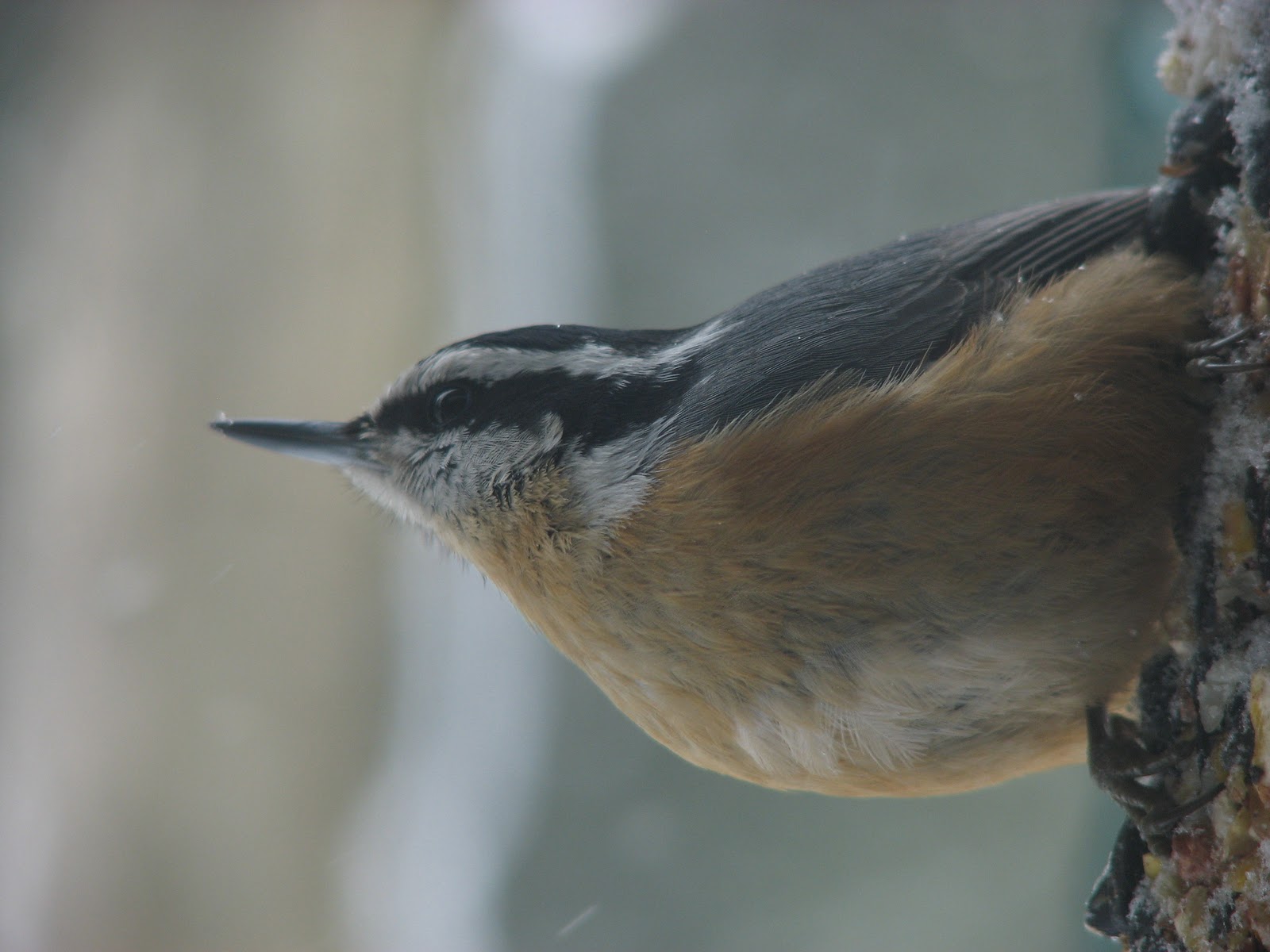
Red-breasted Nuthatch

The collective term for nuthatches is “jar”.  As in a jar of honey.  Don’t know the origin of the term, will investigate.

At Protection Farm we have two species of Nuthatch- The Red-breasted (Sitta candensis) and the White-breasted (Sitta carolinensis)

-From Wikipedia: The Nuthatches are a genus, Sitta, of small passerine birds belonging to the family Sittadae. Characterized by large heads, short tails, and powerful bills and feet, nuthatches advertise their territory using loud, simple songs.”

-The name Nuthatch refers to the birds propensity of wedging an insect or seed in a crack and then going at it with the beak. There are 24 species currently recognized world wide with about 15 occurring in southern Asia. North America has 4 species

-The Brown-headed Nuthatch (Sitta pusillia) (southeast USA)

-Pygmy Nuthatch (Sitta pygmaea) Western North America from British Columbia to Mexico

-Red-breasted (Western and temperate North America)

-White-breasted (from southern Canada to Mexico)

There are nine subspecies of the White-breasted including two found in Mexico: S c mexicana found in Western Mexico, and S c kinneari, found in Guerrero and Oaxaca
Both the White Breasted and the Red-breasted Nuthatch occur year round at Protection Farm. The White-breasted nest and breed here for certain, the Red-breasted are migratory and subject to seasonal irruption.


Male
White-breasted Nuthatch  
Sitta carolinensis


The White-breasted Nuthatch is a common year round resident at Protection Farm.
This small bird is the largest of North America’s nuthatches. It is non-migratory and seems to be paired with a mate year round.  It can be very friendly and is extremely vocal. Its nasal yanking call is very familiar in every season around the woods and feeders. It is especially noticeable in winter as one of the few resident species of birds. Jajean calls these birds “Squeak-toys” because of both the call and the song.


White-breasted Nuthatches are active members of foraging flocks of chickadees, especially in wintertime. The flock behavior makes it easier for them to watch out for predators. They eat nuts and seeds in the winter, which makes them familiar winter feeder birds.  In the summer they eat insects and larvae as well as seeds. They favor mature deciduous woodland.

Feeding behavior includes creeping up and down on tree trunks, and hanging upside down. They probe natural furrows and crevices for food.  They do not use their tail feathers to lean on as woodpeckers do. These birds have evolved enlarged hind-toes to enable this behavior.
Male walking below Downy Woodpecker on Suet Feeder

Male, note the shiny black cap

Female-blue gray cap

Enlarged hind toe for easier creeping and clasping
The adult male has a shiny black crown and forehead. Its black eyes stand out against the white face. Its back is bluish-gray, its underbelly and undertail white and chestnut.  The female and young birds are generally paler with a lead gray crown and forehead. the beak is slender, powerful, and sometimes slightly upturned.

female resting in pin cherry as male feeds


Male

Note the Chestnut colored under tail feathers

Courting takes place in late January.  According to Stokes, paired birds hang around together all year long and establish some independence starting in late autumn. By late January they begin to reestablish closeness and by early spring they are in “complete synchrony.”  It is this late January time when you will notice that the male and female stay within 50 or so feet of each other. During this time the male will begin singing its song from the tops of the trees in early morning.

I noticed this singing this morning just at dawn.  We had an unusual dawn today. It was a brilliant sunlit dawn and the temperatures were astoundingly cold. In nearby Franklinville, a mere 10 miles from Protection Farm, the temperatures hit -24 degrees F at 7am.  Here it was -15. This was the coldest temperature in several years. And yet at dawn, I could hear a Nuthatch singing from the tree-tops. Theoretically the female will then come to the male and they will then go off and feed together.   Also according to Stokes, one of the most prominent features of courtship is called “mate-feeding.”  The male will get excited and find food and bring it to the female.

“Usually the female receives food with little or no display, but he males behavior may vary. He may run along a branch in a straight line to the female rather than the usual zig-zagging. Sometimes the food in the male’s beak is not accepted by the female and he will hide it in a crevice for later retrieval. Mate feeding increases in frequency as breeding, nest building, and hatching approach. Once the young hatch, this activity stops.”

Nest building and breeding take place in late March, April, and May.  By late July the young have fledged and the adults return to more solitary behavior. Nests are typically built in natural tree cavities or abandoned woodpecker holes. Although populations remain fairly steady, habitat loss such as the removal of natural cavity structures is a threat. A single brood of between 5-9 is raised during the breeding season. The eggs are incubated for about 2 weeks.

Today, as the temperatures slowly rose into the 20’s there were at least three pairs of Nuthatches feeding.  It was rare that more than one appeared on the suet, which is their favorite, at one time. Usually one would come in and feed and the other would wait just off in the nearby pin cherry trees.  Occassionally a male would linger longer at the suet, and just sit there not feeding. The female would sit patiently for a while, but occasionally would fly in and make a bit of a racket chasing the male away.  Occasionally two females would come to the feeding station at the same time. They would not feed adjacent to each other, but rather one would be at the suet, and one would be at one of the regular feeders.


Red Breasted Nuthatch 
Sitta canadensis
This bird, common during the winter at Protection Farm is a migrant.  It can breed in this area.  Irruptions from the north including boreal areas occur seasonally due to conditions including availability of food. Not all populations migrate.  According to Cornell some populations move south in great numbers in years when cone production is poor in their breeding grounds. This happens in approximately 2 year cycles. Some years these birds show up as far south as the Gulf Coast. It can winter through out most of the continental us (not Alaska).  It also breeds in the Rockies, south to the Mexican border and along the Pacific Coast. They were once resident on the Mexican Isla Guadalupe, on the Pacific Coast but have been extirpated since 1971. Occasional vagrants have been recorded in the Mexican states of Sinaloa and Neuvo Leon.

These birds begin migration relatively early, sometimes in early July.


They nest in trees, sometimes high in trees, sometimes only about 15 feet above the ground. They use resin around the entrance of the nest hole and on the inside. They may use their beaks or a piece of bark as an applicator. The resin keeps predators away. The Nuthatch avoids the resin by diving directly through the entrance hole.

Their call and song is very similar to the White-breasted Nuthatch.  The call can be slightly more nasal, and the song can reach more of trill. Some say that the pitch is slightly higher than the White-breasted.


Red-breasted Nuthatches are smaller than the White-breasted. They have a distinct cap stripe and a black eye stripe. It is the only North American nuthatch with an eyestripe. Both sexes have dark gray backs and wings, and reddish underparts. The female has slightly paler underparts.
The male cap is starkly black and the female’s is slightly gray and offers little contrast to the back gray. 
I have not noticed that these birds appear in pairs in the winter. Each bird seems to be solitary. They may begin to pair in March. Eggs are laid in April and May.

Food seems to be the same as the White-breasted. Nuts and insects. They are fond of conifer seeds.

Both Nuthatches tend to flock with Chickadees and other winter flock birds including Titmice, Junco's, and White-throats. 

This was my very first photo of a Nuthatch, taken in 2009


Sunday, January 23, 2011

Winter Quiet

The first day of the storm.
This whole January has been cold. Air temperatures have been below normal almost every day. It has also snowed at Protection Farm nearly every day.  Cities along the Northeast coast, New York, New Haven, and even up to Concord and Portland have already received more snow this year than they usually do in a whole year. And today is January 23. We have had been some pretty big snows and winds here. Nothing like the dark howling blizzards that I have seen in some winters, but the low roar has picked up several nights in the treetops. One night it almost felt like the forest around the house was being lifted up,  but that passed in a few hours.  


Its seems that it has been snowing every day. The snowpack is about 3 feet here at the farm.
I guess you could call this a typical January in Western New York. But is sure has been cold.
The cold has come in on a couple of brilliant and clear fronts.  We have had three cold fronts in the past two weeks.  Tonight is the 4th.

Dawn of Saturday January 22

January 22

This could be a sand dune?

Bird feeding station at living room picture window

White-breasted Nuthatch visiting during the storm 
Hairy Woodpecker has been here every day.

This Red squirrel and his pals come around every mid morning and raid the whole feeding station.  Usually they don't scare off very easily. Today I let them get their fill for about two hours and then I scared them off, and they stayed away the rest of the day.
Tonight is predicted to hit -5F in Buffalo, 40 miles away. It is sometimes as much as 15 degrees cooler here on Protection Farm.

Right now, the sun has set. It is very quiet outside. Not a bit of wind. 

Many of the January evenings have brought with them calling screech and Great Horned Owls.
I haven’t heard any for almost 5 days, since the big storm that dumped a foot or more on us through yesterday morning.  So far tonight, no owls. The sky is clear. It is cold. The stars are sparkling.
As we settle into the night we are bundled up against the cold. Jonna and I wrapped in blankets and both cats sitting nearby, looking for any chance to climb onto a lap.  It is very winter quiet outside right now.

Sunday, January 16, 2011

Blue Jay


Cyanocitta cristata 


My earliest inclination to pay attention to Blue-Jays, probably had something to do with the fact that both the birds and myself were referred to as “Jay”.  My earliest instincts toward curiosity were immensely stimulated.  This probably started within a few days or weeks of my birth. My family had an place on Newfound Lake in NH and we spent an enormous amount of time there until I was much older. As I near my 60th birthday, this lifelong relationship with this species, continues unabated. 


Jays, like over half of all bird species, are passerine.  Passerines are sometimes referred to as “perching birds” or “songbirds”. They form one of the most diverse vertebrate orders.  For example, they have twice as many species as the largest mammal order, Rodentia. Blue Jays are of the family Corvidae, also referred to as the “crow family”. Other members of this family include crows, ravens, magpies, and nutcrackers. 


The Blue Jay (Cyanocitta cristata) is part of group known as “American Jays” or “New World Jay’s”. American Jays include a variety of scrub jays and magpies, including Stellar’s Jay (Cyanocitta stelleri):  the Florida Scrub Jay (Aphelocoma coerulescens); the Pinyon Jay (Gymnorhinus cyanocephalus); the White-throated Magpie-Jay, (Calocitta Formosa); and the Black-billed Magpie (Pica hudsonia).


Corvids are very intelligent birds. This is true of the Blue Jay. They display complex emotions, relationships, and behavior that reveal a very sophisticated species.  The have very tight family units.  They have a remarkable language that uses succinct nuanced vocalizations, expansive posturing, and distinct social relationships. The Blue Jay, like other corvids is a very social species. The socialize with their own species, and with other species including humans. The vocalizations alone, well documented, help to characterize these relationships. These birds are characterized for instance by their raucous and sometimes festive gatherings. They are known for  their loud warning calls that alert all about to the presence of predators such as hawks or human hunters.  They are known for their persistent scolding if things are not going the way they think they should be going. They have often expressed pointed opinions toward me about my activities relative to feeder stations, and other activity that they wish to comment on.  Sometimes when I get too near to a more or less avian-specific gathering, or a nest, and often when I am just innocently walking a trail or across a meadow they endeavor to express an opinion. Often they are just letting others know that I am in the territory. Sometimes they alert me to the presence of others.


Hear Blue-Jay vocalizations here: http://www.allaboutbirds.org/guide/Blue_Jay/sounds


What is commonly referred to as the Jays warning call, the loud “Jay, Jay, Jay” is a distinctive and important vocalization.  Jays will use this call when they are engaged in mobbing of a crow, or bird of prey. Crows, in the same bird family will use these calls for the same purpose.  I have often noted that they will also use it when passing above a creature including deer, fox, and humans, walking in the woods or in the fields. This “marking” behavior plays a role in alerting other animals of the presence of a potential intruder. I know that and when I am out and about, especially in more wilderness areas, I pay attention. I have friends that swear that Blue Jays will find wandering feeral cats and follow them and make this call sound. My grandfather used to tell me that the Jays were marking my presence for other animals. He also taught me that if we listened to the Jays and crows we could find other animals, mobbed hawks or owls, and sometimes deer.

Other Jays songs and calls are very familiar. There is the sound resembling the liquid gurgle of the swinging gate. This is a beautiful and surreal, melodious, and soft.  I am not sure exactly how the bird uses this song but sometimes it there is a response with the same vocalization from other Jays. I think it indicates tenderness and relationships. Perhaps this helps them keep track of each other. They also have a number of other calls and songs, some quite sweet and gentle, some startling and harsh.  Breeding and fledging season bring out a whole new world of vocalizations. 


Jays also like to imitate and mimic other birds. This includes from my personal observation, catbirds, cardinals, and hawks. It’s a close call on the catbird mimic but sometimes it seems like they are actually imitating a real cat. Catbirds themselves are mimicers, so this language gets very complicated. I have spent considerable time talking with Blue-Jays. If I get lucky I can make vocalizations and a Blue-Jay or two will stare listen or at least appear to stare at me curiously. Once in a while they will tilt their heads as if a sound that I made is very interesting.  Occassionally a Jay will talk back to me. Usually this happens when they are about to depart. I have noticed that they will sometimes emit a little gurgle and fly off.  I am not an expert but I like to shout “see ya later”. They are probably saying, “Not if I see you first”.

Blue-Jays are classified as “omnivores” and will eat other animals including mice, frogs, other birds and eggs, caterpillars, grasshoppers, and beetles as well as fruits, seeds, and nuts. They are subject to the predation of hawks, and crows.  Blue Jay eggs and young are especially vulnerable. The Blue Jay has been observed using tools such as sticks to get food. It can live for a relatively long time. Blue Jays studied in the wild have been identified at 17 or more years old. One captive female is reported to have lived 27 years.  Research suggests that the average life span of a Blue Jay is 7 years. Both sexes are capable of mating at one year.


Blue jays are thought to be monogamous with pairs bonding for life. Some of their behavior includes bobbing motions when in courtship and when being aggressive.. It is thought that submission is signaled by fluffing up of feathers, and raising the crest. 

Their range covers much of central and eastern Canada and the United States from the north to Florida and Texas. They are more frequently seen on the northern west coast and have become common in the San Francisco area. Jays can migrate in large flocks  hundreds of miles, depending on conditions such as weather and food supply. They are very adaptable and their habitats are diverse and wide ranging.


It is thought that during the end of the last glacial epoch, about 12,000 years ago in the Niagara Region when the ice was receding, Blue-Jays were primarily responsible for spreading the seeds of the Oak and Beech forests, thus helping the hardwood forest expand as the climate warmed. They have long been a part of our native ecology.


At Protection Farm we see Blue Jays year round.

Depending precisely on seasons and weather conditions, we often see them gathered in noisy flocks of varying sizes.   They roost in woodlands and love pines and other evergreens for cover. They enjoy many habitats for access to food ranging from nuts and seeds to insects and other small animals.

They come to our feeders often commanding the scene with a precise and determined presence that seems to tell the other creatures present that disorder will not be tolerated.

More than once I have observed some sort of terrible squabble going on at the feeders. Have no doubt that when the critters get riled up they can put up an attention-getting ruckus that attracts all sorts of eyes and ears, including predators that are anxious to take advantage.  Sometimes it starts with Red Squirrels complaining and fighting. Chickadees, juncos, and cardinals join the fray.  Nuthatches and woodpeckers will come in and observe.  It all comes to order when the Blue jays, sometimes a pair, sometimes more, come screaming in, take up posts and aggressively challenge the gathered mob to either quiet down or disperse. This almost always works, except when there are crows present. In the pecking order, even solitary crows often seem to be slightly above the Jays.  (of course it is not abnormal to see a flock of jays mobbing a crow)

Their behavior jumps quite to the other extreme when it comes time to cross open territory such as fields and meadows.

This past month of January I have been outside nearly every day. Toward the late afternoon and evening I have observed over our Protection Farm fields, Jays moving in flocks. It seems that they are keenly aware of my presence. Scouts see me, mark me and move on to an appropriate post. The word of my presence travels fast. I am not sure how far it travels.

The sizes of the flocks varies.  Sometimes four or five, sometimes a dozen or more.  When they come to the edge of the fields what already seems like serious business seems to have an organized uptick.

The birds settle.  Scouts appear to check out the crossing. There are vocalizations of “Jaay”,  or “Jay, Jay” that seem to be pointed. There are calls, and often responses.  The voices seem distinct, inflections and nuances are clear, but it is generally this alerting “Jay” call that dominates the air.

It is easy to think that they are signaling their locations to the other Jays. There often seems to be a call and response going on.  And then, suddenly,  one by one they become solitary silent rockets flying low and straight over the open ground crossing from one side cover to another.

There are many individual flocks that are crossing and it is easy to speculate there is a lot of familiarity amongst individuals and the flocks and groups. These probably are family groups, and probably related groups that have been flocking together through the winter, the seasons, and possibly even the years.

There may even be a few trusted scouts and leaders that are recognized by the other birds that are on duty. Maybe they move on and others take there place.  

It appears clear that there is an avian culture that seems to have complex activities and behaviors, can act very disciplined, or outrageously unruly. They appear to act cooperatively with other Blue Jays and Blue Jay groups

Recently at Protection Farm, we had a midwinter warm up.  The great snows of earlier in the winter have all but disappeared with only a few patches of the white stuff lingering in the big plowed piles and in the occasional low spots.  The marsh is flooded like I have never seen it.  This is both due to the melt and to the, I am sure, work of the beavers that built there over the late summer.  It is magnificent.

One day last winter Jonna and i were in the house with the kitchen door open just a little bit (it was almost 50 degrees). We heard a very distinct hawk like call very close by.. And then again.   It sounded like a red tail but how could one be so close? The call shook the house. Would a Red-tail perch on the porch and make the call?  The sound was coming from just outside the kitchen door and we slowly peeked our heads around half-expecting to see one. There on the porch rail instead was a big Blue Jay.  It was puffing its neck feathers, fluffing and erecting its crest and opening wide its beak as it let go a magnificent series of slow   “phzzzzzeeer, phzzzeeeer pzzzzeeeer”  Even as I was watching this Jay make this display, I still wanted to look toward the sky and see if a hawk was circling and assuming the Jay was issuing a warning.


As we looked around the yard from our vantage, there were no other visible birds anywhere around the usually busy feeder.  We guessed the Jay had done a good job of warning its kin and the others usually vulnerable and open at this feeder station.

Then the Jay hopped up to the bird feeder and began hastily feasting on sunflower seeds.
After  a few seconds and still thinking that there must be a Coopers circling somewhere nearby I decided to get a closer look. I moved toward the open door and the Jay saw me. It flew off. In made a beeline for the tree line. It landed visibly in brush just near the pathway leading down to the old cabin.  I went out on the porch to get a closer look.  As I reached the porch, the jay issued forth a loud wet squeaky gate call.  Just one quick call. And then from beneath me, from beneath the cover of the and bushy and old flowers along the now snowless walkway and from under the porch, erupted a whole lot of birds.

Several dozen birds. At least -four cardinals, a bunch of chickadees and juncos and several tree sparrows. They, just seconds before hidden, all scrambled for the safety of the nearby woods.

I continued to search the sky and the tree line for what I still thought might be a hawk. Guess what? No hawk.  I am convinced that the Jay scattered the other birds away from the feeder with its imitating hawk call, and then took advantage of a more peaceful meal. Until that is I cam out to upset its meal plan.

About a half an hour later there are about 50 birds on the front and back feeders, which is a fairly common convocation of the avian population around here.

There are of course ongoing great cultural, scientific, and ornithological arguments as to what all of the activities, sounds, and the socializations mean. It is a beautiful time to be alive as dedicated scientists engage in the discovery of the meanings of these things.  Someday we may have a better understanding of how these precious animals think and why they do what they do.  No only which sounds are warnings, love songs, which sounds relate to finding food, and which are just social chit chats may lead us to a better understanding of how these animals think, and, what they think.  These are all extraordinary possibilities, discoveries as we humans get serious about learning language. Many cultures have long known and practiced listening to nature. It is important that we all realize that animals like the remarkable Blue-jay these talk, and it is high time that more people learn that they talk to us.

First Blue-Jay Moon

From the beginning I have had a real thing for Blue-jays. They are fast, powerful, beautiful, confident, and extremely smart.  They can be aggressive, loud, and intrusive. They can also be curious, gentle, and are considered guardians of the wild. They are communicators. They let you know when they are around. Even in breeding season, although they tone it down, they are marvelously vocal. They have always, for me, been part of the chorous of the year round wild.  My first appreciation of music came from these Jays. Most often you will hear them before you see them. At Protection Farm, no matter what the season or circumstance, they are constant and consistent voices in the air.

These attributes encouraged me to pay attention to them from since I was very young.  In fact, this bird helped introduce me to a lifelong passion for nature and birds.


I have known Blue-jays from the time I was born.  My mother used to tell me that Blue-jays attended my birth. Or at least they were outside the windows when I was delivered, and remained nearby even after we returned home.  She used to tease me that Blue-jays followed me around when I was outside.  It may have been true then, and it certainly is now. She told me that the Blue-jays inspired her to knit a fabric wall hanging of a white-tailed deer fawn while she carried me in her womb. I still have that. She also made a copper/enamel piece that showed me holding a dove. She said that the image came from a first Blue-jay Moon dream. 
My mother made this copper/enamel plate and told me that this child is me

In my birth year of 1953 I spent a lot of time outside. We had a place on Newfound Lake in New Hampshire, and I was nourished by those mother waters until I was nearly 20. In my first winter, I was outdoors quite a bit up there in the piney woodlands and lakes of Northern New England. My parents loved the outdoors and they made sure that I was very familiar and comfortable with the out of doors. That first winter for me, the Blue Jay moon of January was every bit as famous as it is today. It was celebrated outdoors. Not a loud celebration, but noted, and somewhat cerebral.

My family  noted First Blue-jay Moon.  The ancestors apparently adored the day, the concept and the experience. It has been passed down to me.  I think my ancestors must have adored me. I always try to think of what they did to plan for a better future for me. I want to hand this down. First Blue-Jay Moon occurs on the first full moon of January.  The concept is to go outside and celebrate nature and future generations.  It has been handed down as the day that the ancestors worshiped those generations to follow. It is kind of a twist on the Mexican Day of the Dead. Instead of revering and celebrating those that have passed, First Blue-jay Moon is a day to celebrate the future and those that will come. It can be described as a 7th generation planning exercise. How can we make the future better for those that come after us all the way to the following 7th generation? At the same time it is about the immediate future.  What can we do better this year for instance? Probably one of the reasons that First Blue-jay Moon comes just after the somewhat narcissistic New Years Resolution time.  This year (2011) the First Blue-jay Moon, and the only Blue-jay Moon, falls on January 19.


Saturday, January 15, 2011

Refuge for a Cardinal


Today at Protection Farm it is cold and incredibly snowly.  We are back into a cycle of constant precipitation and right now one of the biggest snowstorms of the year, at least in duration, is occurring. We are accumulating snow at a rapid rate, the car is parked down near the street, and it is beginning to remind me of the winter we spent at Hobbit Hollow over 20 years ago when we were snowed in for about 6 weeks and I had to ski about 8 miles round trip to pick up provisions from Hogans in Java for our new family.

Today Jonna and I  are sitting next to our picture window, watching the endless snows, and watching a very active bird feeding station.  Among our visitors are a male and female Cardinal that have been regular residents here, we think, for a number of years.  I am not 100% sure but two winters ago I had an encounter with a cardinal and I like to think that the male cardinal that we have here now is either the same, or related.

I wrote about this in my Protection Farm Journal notebook.  It is dated January 4, 2009.

"we have a family of Cardinals that have been regular visitors to our feeders. There is an adult male and female, and what I think are two juveniles, both born this past summer.  It is hard to tell for sure, as this is just casual observation, but it appears that this is a family that has consistently been here.


Yesterday was very cold. I was sitting under a blanket on the couch next to the big picture window which is our window to the feeding station.

I wasn’t wearing anything except my socks and was comfy under the blanket on the couch. That might seem like TMI, but it is entirely relevant to this story.   I noticed the male juvenile perch on one of the Pin Cherry branches that are just off the porch.  I had my camera and snapped a few shots. Then the Cardinal  came into the feeders. There were about a dozen other birds at the feeders including two Mourning Doves, several Chickadees, a couple of Goldfinches, and  some Junco’s. 

This Cardinal ended up in my living room.

I think it knew it was coming inside, and was trying to get around the Mourning Dove at the bottom right of the photo.

The cardinal was acting nervous and tentative.  It was obvious that all of the birds were a little extra energetic.  It struck me as odd. The Cardinal was on the porch railing when something spooked all of the birds and they flew off.

 It was a serious scare as a couple of Junco’s flew right into the picture window in front of me.  I was sitting down on the couch, slouched down really and didn’t have a great view, but the sudden flight panic got my attention.  The birds that ran into the window were not traveling fast, not at top speed and they bounced off the window relatively gently, and kept flying. That is the norm at these feeders. They are close enough to the window that the birds never pick up enough speed to do any damage when or if they hit the window Usually.

However this time, whatever spooked them created enough of a panic that the Cardinal flew directly at the window and hit it with a hard thud.  I saw it hit out of the corner of my eye and as I looked up, I saw a shadow fly overhead and away. I am guessing it is our constant companion  the Red tail.  I have never seen the big hawk hunt at these feeders but when he is around he always gets everyone’s attention. 

There was a red feather stuck to the window where the cardinal hit.  It was a big hit, but I assumed the Cardinal flew away.  I lifted up off the couch disturbing my cats who were sitting on top of the blanket and I looked over the edge of the window and down in the snow.  I was stunned by what I saw.  Two scraggly cardinal feet sticking straight up out of the snow, and a red tail feather.  It was kind of silly and cartoonish looking. The legs were wriggling a bit, but I got the message that the bird hit hard and had nosedived into about a foot of soft snow.

I knew I had to act quickly. I knew that the shadow that had passed may return to claim a prize. I knew it was bitter outside, and I knew that the cardinal was probably out cold.  This wasn’t my first bird rescue, and I knew I had to act fast. The big problem was that I was, as I mentioned earlier, nekkid except for socks.  I didn’t have on any pants, or shoes.   In defense, this is not my usual attire, but I had earlier emerged from warm shower  and just decided to get under the blanket and watch the storm for a bit. My cats did not mind my unclothed state. Did I mention that it was cold out? Blizzarding?

I put the camera down and rushed around for a few confused seconds looking for pants, or pajamas, but all I could find was my snow boots.  I decided that bird rescue valor called for no modesty and so out I went into the blowing snow. It was about 20 degrees and felt much worse.  It was only a few steps to the bird, and I reached down into the snow bare handed (and bare everything else)  and plucked out the unlucky bird.  At that moment a car drove by on the hardly plowed road which was about a hundred yards from the porch. It was snowing pretty intensly so I don’t think anyone saw me. At least they didn’t blow the horn.

As I lifted the bird out it was obvious that its beak was full of snow. Stuffed really.  It eyes were also covered with packed snow. The first thing I did was notice that it was entirely unconscious and that its mouth was entirely clogged. Must have hit the snow with it open.

I was able to reach in with my fingers and dig the snow out.  I could see down its throat so I knew I had cleared it.  I cupped the bird in my hands and in the house we went.  Did I mention the cold? Shiver me timbers! I was pretty cold.  As I walked in I saw the our cats anxiously perched on the couch where they had been watching me out the window. They were very curious about what I had found. We, the cats and I,  are in the habit of sharing found objects, especially living objects or recently dead objects with each other.  They expected a show and tell.  I closed the door and sat on the couch surrounded by curious cats and cupped and warmed the bird. I put my hands around its body, brushed off all of the snow, covered its eyes and held it close to my chest.  It’s heart was beating. Wow!


I hoped that it would revive from its shock in a few minutes.  Many times when birds have collisions they go into shock.  If they are handled gently they can often be revived.  If they are not given emergency care they can expire. Sometimes they will just freeze to death or perish from some other sort of exposure. Or a predator gets them. 

Gradually this Cardinal came back. By now I had managed to find pajama bottoms and a t-shirt and had managed to put them on. After about five long minutes, one Cardinal eye popped open.   It didn’t appear to focus or exhibit a lot of comprehension, but I took it as a good sign. And then the other opened. After about five more seconds the Cardinal lifted its head and stared directly and hard at me. I tried to imagine what it was thinking.

As it regained its senses, it began to wiggle and I grasped it a little tighter. I have handled a lot of birds, mostly through banding and so I know how to hold a bird. Cardinals can be very aggressive, not as aggressive as chickadees, but they can still give a cuticle a good bite. I have experience with that and I was able to give this bird a comfortable (for both of us), squeeze, one that kept any blood from shedding from either of us. 

As this scene unfolded, the cats were becoming more and more curious, but not at all aggressive, just inquisitive. They kept a respectful distance, but kept their attention on us.

I took a  picture.

I managed to both find some clothing and snap this badly out of focus picture of the Cardinal and I.
He is just starting to realize that he has been rescued, or capture, or is conscious. Probably had no idea what hit him 
Now he is thinking that he wants a piece of me!

 
After another few minutes the Cardinal made a quick move and jumped out of my hand and flew into the Christmas tree. This startled me and panicked the cats who both fled the room. Rosie went up the stairs and Red Cat into the basement. I couldn’t help but to recall Red Cats valiant battles with summer moths and house flies. He usually won by eating the intruders but it was always an exciting spirited spectacle until the final moments.

“Brave hunters “I said out loud. 

The Cardinal perched in the living room Christmas Tree like an ornament and stared at me in still dazed state. I went over to it and easily recaptured it.  I held it close and covered its eyes again, confident that it was well on the way to a full recovery. We sat there in silence for a minute or so. And then it began to screech.

It screeched like a little baby, which is really what I think it was. I am pretty sure that this is a juvenile male, and was still in the company of its parents and sister. It was probably less than 6 months old. It made a racket. The cats couldn’t help but to come running.

Red Cat came close and gently sniffed the birds head.  Then he went away about four feet to our left and sat and watched. Rosy sat about 4 feet away to the right,  staring with incredibly wide eyes. She was very excited but seemed more curious then aggressive.  It was kind of a neat few moments. 
As the bird continued to regain its senses, I walked it around the room and into the kitchen.  It became a little more calm and stopped screeching.  It reminded me of walking an irritated baby human around in my arms and I talked gently to it.  I even nuzzled it a bit with my face.  I am not sure that this had a good effect, but, well, it was instinctual.  At one point  I started showing it the windows and the outdoors. This elicited interest in this bird.  It clearly recognized the difference between being inside and the outside, beyond the window.  


After a few more minutes I took it out on the porch.  It seemed to happily drink in the fresh air and began to make new noises, these decidedly more friendly than the screeching.  Kind of little chortles and a whistle or two.  It definitely calmed down once it was outside. And I noticed a female Cardinal came to the tree line about 30 feet from where we were and she was very focused on the noisy little bird in my hands. I dint know if it was mom Cardinal, or sister, but it was watching us.

After another moment, I placed the recovering Cardinal on the post of the porch railing. It sat there for a few seconds and then flew-directly back into the big picture window where it hit with a thud.  This time though, it was  a glancing, blow and it   turned mid air back toward me. It flew directly at me and then by my face screeching and looking straight at me. Not sure what it was saying, but I had the sense that if birds could use foul language, I was witnessing it. It flew to a perch in the cherry tree just next to the porch and sat there. The female was nearby but flew off.  After a while so did my little rescued Cardinal.”


The newly released Carinal sat on this branch for a while before flying off 

This Cardinial visiting our feeder the next day. the snow crystals around its eye were very interesting.


This Cardinal at our Feeder on Jan 15, 2011


I am pretty sure that this Cardinal and this Cardinal family are still part of the landscape here at Protection Farm. In fact as I look out at the bird feeder today, on January 15, 2011, I am feeling that the Cardinals that I watch every day are very familiar, and that maybe one of them has been inside my house.