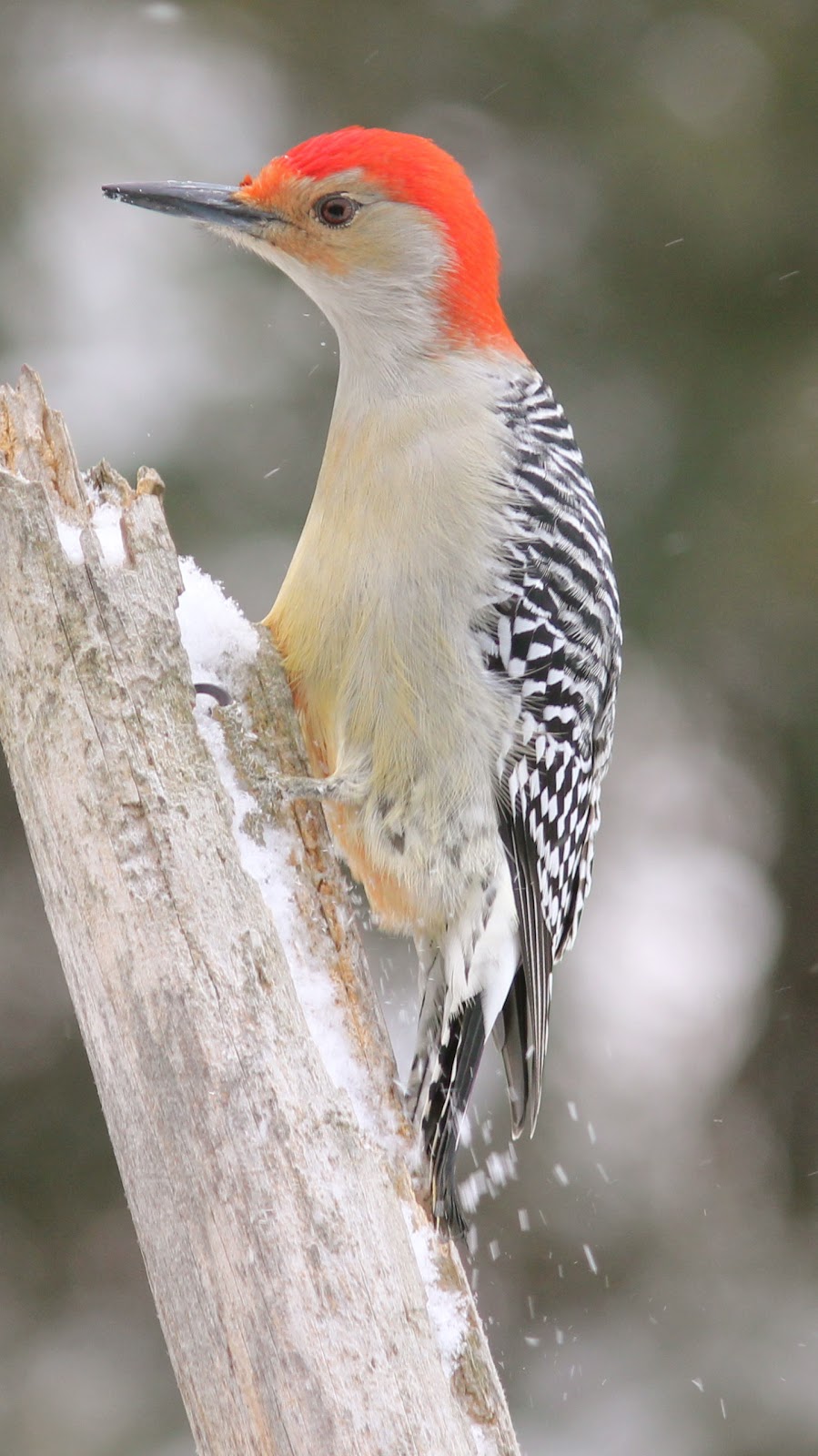
Pileated Woodpecker
Dryocopus pileatus
I did not think that I would get a chance to photograph this great and beautiful animal in my lifetime. It is the largest woodpecker to be found in North America, unless of course the Ivory-billed has not yet gone extinct, which is probable. Surely the Pileated Woodpecker is not the most rare bird on the planet, but it is incredibly shy and it is not that entirely common, at least in my neck of the woods. I have seen it a couple of times, at a distance, at Protection Farm. Twice I have seen a solitary individual flying across the far end of the meadow, two or three hundred yards out. Five or six times I have heard it calling somewhere deep in the woods. Each of these times brings excitement to my heart.
I am well steeped in the lore of the Ivory-billed Woodpecker and wish I had a chance to see one of those before it allegedly became extinct. There is still some hope that they are surviving somewhere in the deep swamps of the south, or in Cuba, but it is a distant hope, and many of my friends refer to the Ivory-billed as the “ghost woodpecker.” Because of the general decline of birds, and because of the extraordinary rarity of my own sightings, I have come to also refer to the Pileated as a “ghost” bird.
Not so much today. I have had an awesome and outstanding encounter and I had my camera with me.
In the past, I have had a couple of close encounters, one of which is described below. And I have never had an encounter in which I had a functional camera. Last Sunday, that all changed.
Sunday March 20, 2011, was the vernal equinox, the first day of spring. It also happened to coincide with what was called the “Super Moon.”
http://science.nasa.gov/science-news/science-at-nasa/2011/16mar_supermoon/
This full moon was according to NASA, the closest to the earth in 20 years and they happen rarely.
For about two weeks, spring has been onrushing. At least the days have gotten noticeably longer after a long dark, dank, and cold winter season. The birds have changed and in the last few days the dawn songs are different. The marsh has become home to over a hundred different birds. We have seen hooded-mergansers, common mergansers, wood ducks, black ducks, buffleheads, lots of mallards and we have had a population of about 20 Canada geese that have been talking it up with the mallards all night long in the marsh for about a week.
The temperatures have been hovering between 25-40 degrees F. Most days have been overcast. About two weeks ago I was up at dawn on what would prove to be a sunny but cold day. I was in my office and went out to my living room where there is a big picture window overlooking the yard. I noticed something moving on the big white pine tree trunk about 20 yards out. It also noticed me. It was a Pileated and it flew away immediately. That was a real exciting moment. I hoped it would come back, but it didn’t. Later that morning and for several days after I went out to the tree and noticed that there had been some activity as the bird had obviously been visiting the tree, and pecking a hole. Not much, but a couple of times I noticed new activity. I hoped. But I did not see the bird again. Until Sunday.
I am up early, it is still dark. I wanted to photograph the supermoon, but it was too overcast. I went to my desk and starting working on the computer. As dawn gradually emerged and the room became slightly lighter, there was a loud thunderous roar outside my window. It was the Pileated calling. The sound literally shook the room and vibrated me to my core. I couldn’t believe what I had heard. I grabbed my camera and changed to a long lens, hoping that the bird would go to the white pine and resume work. I snuck down the still dark hallway, brought the camera to eye level and very cautiously peaked around the edge of the window, which was still across the room from where I stood. Slowly I moved toward a view. I inched the camera forward until I could see the edge of the tree, and there staring at me, in my dark hiding place was a huge woodpecker. I was not near enough the window to get a perfect shot, but I took a shot, and the Pileated moved rapidly around the tree and disappeared. I could not believe that it saw me. But it did.

 |
| a little more of a pushed view |
I moved to the couch, and set up low, fairly hidden from the outdoors world. I put the camera on the back of the couch, crouched down and waited. And waited. I thought the bird might be behind the tree and might come back. But it didn’t. I waited almost 20 minutes before I finally gave up. By now the sun had broken through the clouds and I got dressed and went out to the tree and there was no bird anywhere to be seen.
I decided to head down to the marsh where there was quite an uproar going on between the Canada Geese and the Mallards, at least. I could hear the occasional wood duck.
If you know my farm, the path to the marsh is about half a mile from my front door and you have to go by the barn to get to it. Usually it is difficult to sneak up on any waterfowl in the marsh because the last 30 or so yards is down a slippery steep and very exposed hillside path. They see you coming and the guard birds let the others know as soon as they notice anyone, and usually, especially at this time of the year they are all off before you can get close. Sometimes you can set up in a camouflaged or hidden position and if you are patient, they all come back.
Today, the marsh is very flooded and in fact a large pond has been created that covers much of he lowlands from the hill behind the house all the way down past the hill by the barn and into the marsh. As I went from behind the house to the yard between the barn and the house, all of the Canada Geese and the mallards instantly shut up. I knew that they had seen me. By the time I had gotten to the barn, two crows had flown over me and cawed loudly. This alert set the marsh on fire and the Geese began alert calls and before I got half way to the marsh trail, the entire marsh had emptied of waterfowl.
Just as I passed the barn I heard two bluebirds. They flew over me, close to me, and perched on the fence line near where the nest boxes are. I have been seeing and hearing bluebirds for the better part of three weeks, but this is the closest encounter so far this late winter early spring. I stopped and watched for a few moments, and took a few photos. They moved toward one of he nest boxes and the female actually checked it out. These are possibly the same family that has been nesting here for the last few years. In any case it was a friendly and extremely pleasant encounter. So far the first day of spring was spectacular.


I worked my way down to the now quiet marsh. I stood near the edge and saw nothing. And then a couple of mallards hopped out from some of the underbrush across the way and swam up stream and away from me, quaking like crazy. A flight of woodies came in, circled just above, saw me and flew away rapidly. Next came a flight of mallards. One of them looked different. I snapped a photo. They saw me and moved on.


I sat down and the sun gradually warmed the marsh and me. I edged in closer under some scrub branches hoping I could disappear, but virtually every bird that came into the scene in the next half hour- chickadee’s, blue jays, robins, crows, red-wings, junco’s all spotted me immediately. Some came over for a closer look, but most just flew through. I was about to give up and go back inside and have some breakfast. By this point I had pushed myself back into the leafless branches of the sumac and osier that bordered the marsh. And I heard it. The Pileated was calling and it was flying in from near my house. Maybe it had been up there all along, hiding in the trees by the white pine?
It flew in and landed on a tall dead single trunk, about 100 yards across the marsh. I looked at it for a few seconds trying to decide if I should try to get a photo, or just stay still and watch. It was a long way away, and as yet it hadn’t seen me. I have a 250 mm lens. I decided to take a picture. As I slowly raised the camera it saw me. Snap. Snap. It flew. Snap. And it was gone. Wowowowo!

 |
| Looking right at me! |


Pileateds are very shy and usually solitary birds. They each have a fairly large territory and are in decline because of deforestation. They are huge birds with enormously long tongues.
Description
Life History
Listen
Long Ago, another encounter!
The supermoons happen as rarely it seems as my having a close encounter with a Pleated. Coincidentally the previous close encounter with a pileated happened in 1983, a year when there was also a Supermoon.
That year Jonna and I were living at Hobbit Hollow, in a rustic cabin on a rustic lake in Java N.Y. Our first child, Jajean who was born in April. For the few years that we lived there we had fantastic outdoor adventures. Jajean was a wide-eyed naturalist from the beginning. We would take long hikes, or ski’s in the several hundred acres of woodland, meadow and wetlands that surrounded us. Jajean would ride in a backpack on my back, or in some other combination in my or his mothers loving arms. In the winter I made a kind of sled where he could sit inside comfortably and warm. We were outdoors constantly day and night, seeing, listening, smelling and feeling. Wildlife was abundant and friendly. A family of wild Canada Geese that lived on our pond treated us as if we were part of their family. The would follow us in the canoes, swim with us, and we helped the young ones learn to fly by running along our long dock and jumping into the water. They would follow and leap into the air, eventually learning to fly. They would even sit around the campfires with us and chatter endlessly. I am quite sure that the young geese felt that Jajean was one of them.
Late in the summer, one morning I looked out our bedroom window. Just 20 feet away was a large Norway Spruce with a thick dark trunk that rose about 40 feet above our heads. There on the trunk at eye level was not one Pileated, but four. Two adults, and two young. They were moving along and around the trunk, poking at crevices and crannies. I awoke Jonna and Jajean and we sat for about an hour watching. They did not see us and it was just an astounding time. Jajean stared and occasionally cooed, or giggled. Over the next few weeks we saw them once or twice again, but never so intimately.
 |
| Baby Jajean on my hand made sled |
Coming soon, more photos from Hobbit Hollow